
4 hr 45 min
Hassan II Mosque Premium Guided Tour in Casablanca
- Multi-attraction access
- Mobile voucher
- Flexible dates
- Free cancellation
Casablanca Mosque Tour — Guided Entry to Hassan II
Marble drawn from the Atlas, light drawn from the Atlantic
Compare fares, pick the fit — all bookings are mobile-voucher and eligible for free cancellation where shown.
4 hr 45 min
4 hr 30 min
12 hr
Worth it for nearly every foreign visitor
The casablanca mosque tour costs 140 MAD for a foreign adult, and that fee is not optional — it bundles the mandatory guided walkthrough into the entry price. What you buy is access, not a building you could photograph from outside anyway. Hassan II Mosque is one of the very few Moroccan mosques that admits non-Muslims, so the 40-60 minute walkthrough of the prayer hall, cedar ceiling, Venetian-glass chandeliers and the underground hammam is genuinely hard to replicate elsewhere in the country. Guides run in several languages and explain the marble sourcing and retractable roof mechanics you would otherwise miss. Value math: roughly 2.30 MAD per minute inside a space that seats 25,000. Casablanca mosque tours pay off for first-timers, architecture-minded travellers and anyone spending under 48 hours among Casablanca landmarks. Skippable if you have already toured Morocco's madrasas extensively or resent fixed-pace groups.
Bottom line: Buy the casablanca mosque tour tickets — the guided casablanca mosque tour tour is the only legitimate way inside, and 140 MAD is fair for it.
Hand-picked experiences loved by thousands of travelers
13 hours
Free Cancellation
Discover Morocco's coastal charm on this guided excursion featuring the Hassan II Mosque and historic Casablanca districts.
4 - 5 hours
Free Cancellation
Discover Casablanca’s iconic landmarks, art-deco charm, and coastal beauty on this comprehensive private 5-hour guided excursion.
5 hours
Free Cancellation
Discover Casablanca's spiritual roots on a private journey through mosques, churches, and historic Jewish sites.
Pass through the metal detector and bag check at the visitor entrance before your scheduled slot.
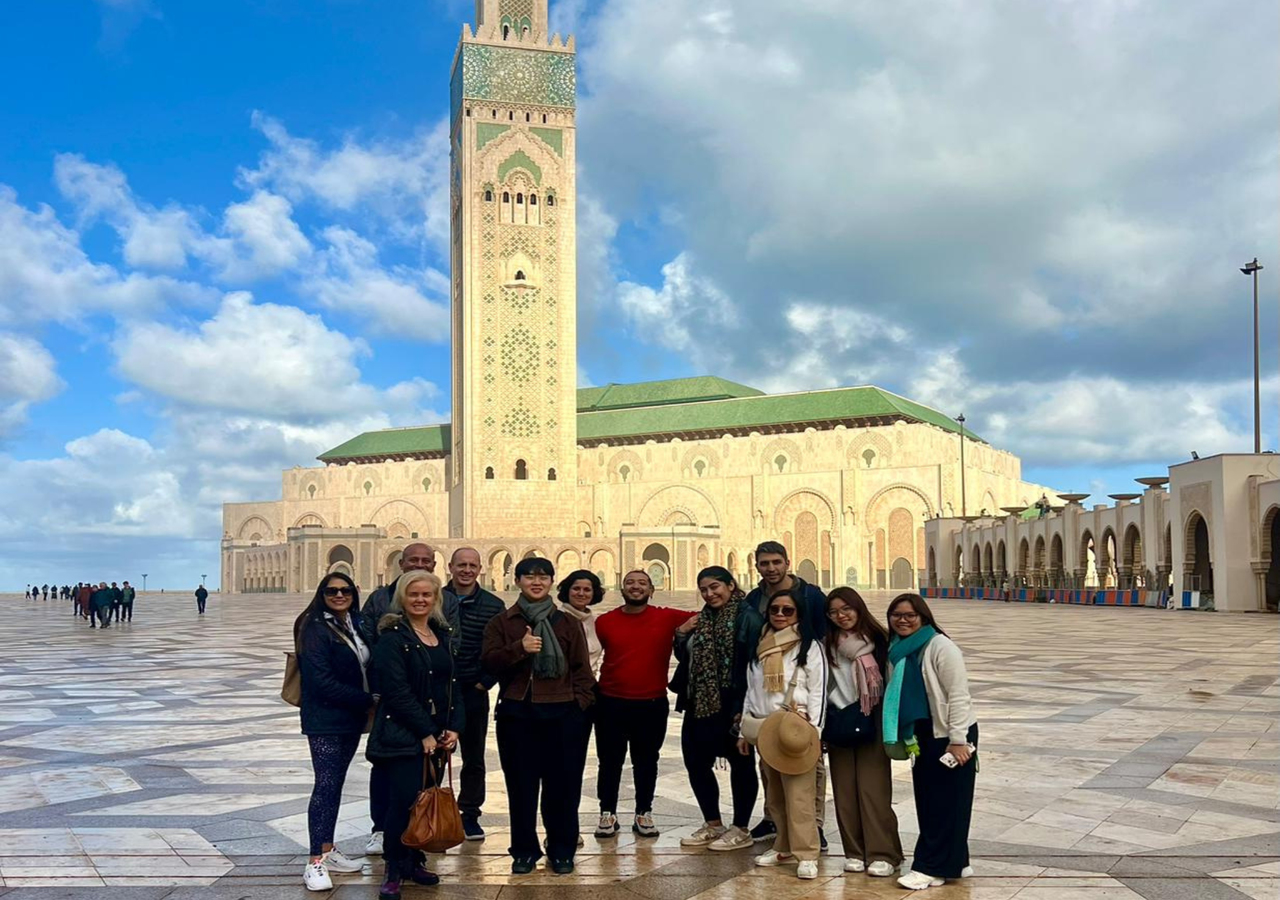
Guides gather groups by language in the vast sahn courtyard before entry begins.
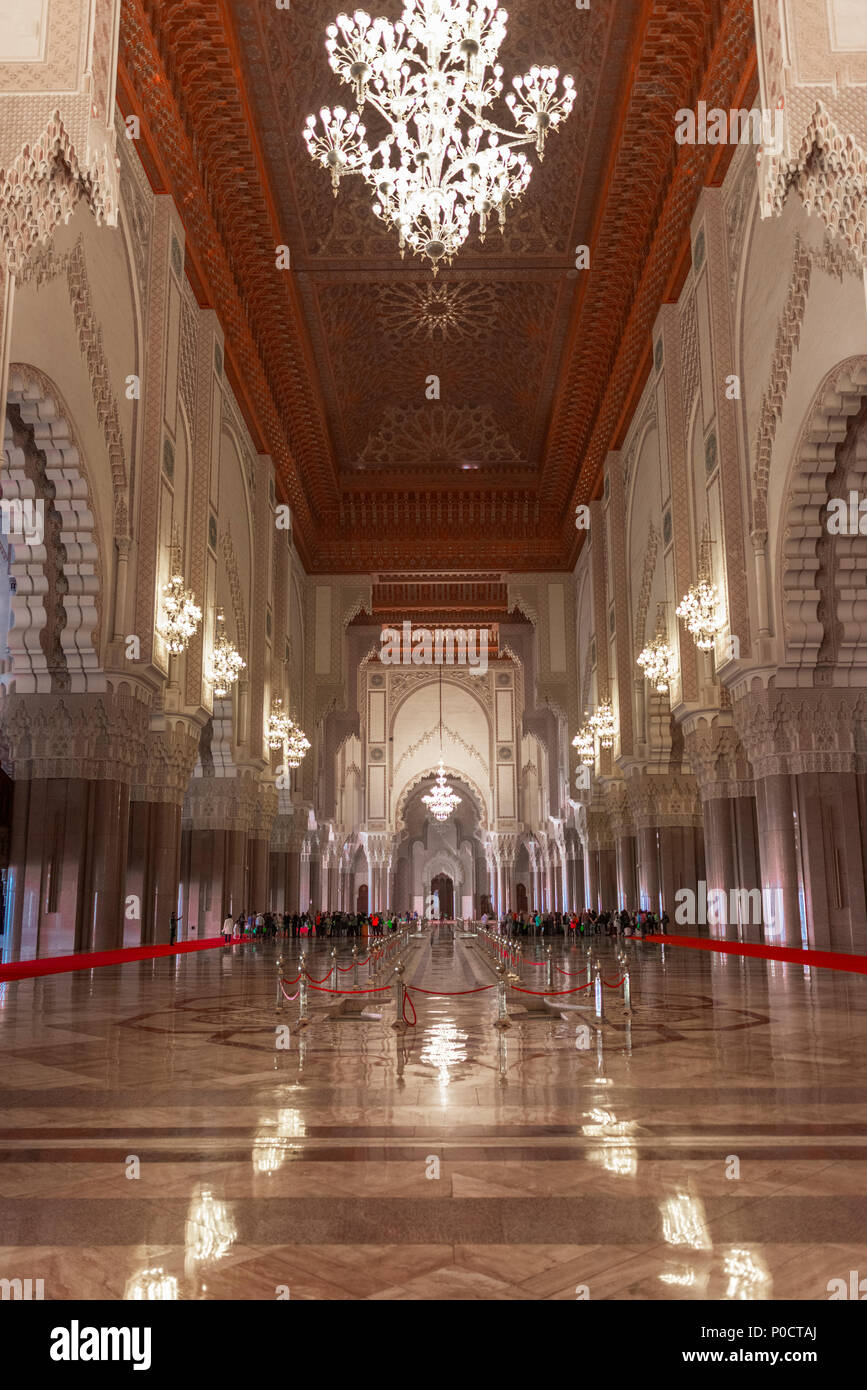
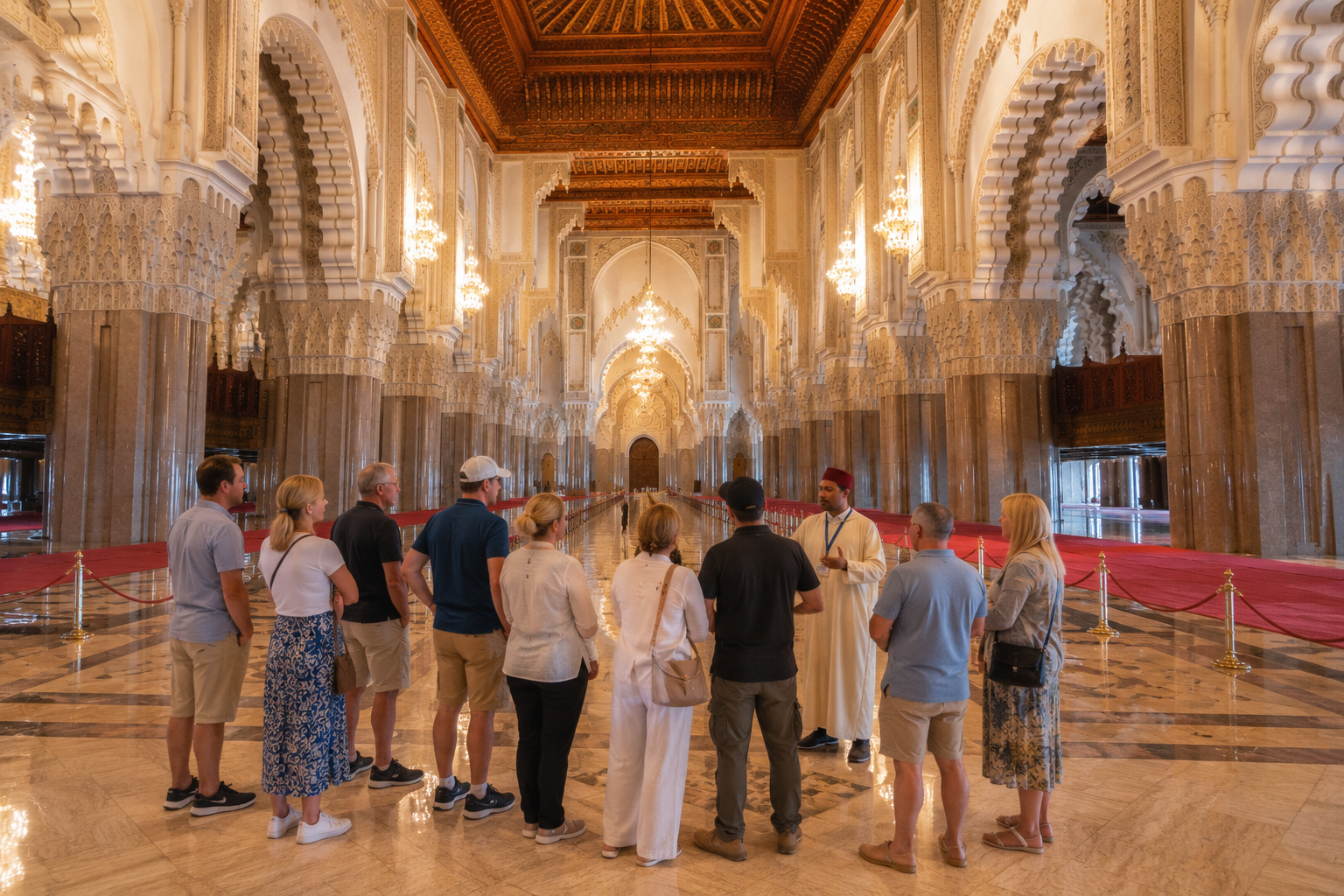
Walk through the 20,000 m2 prayer hall, viewing the retractable roof, cedar ceilings, and zellige tilework.
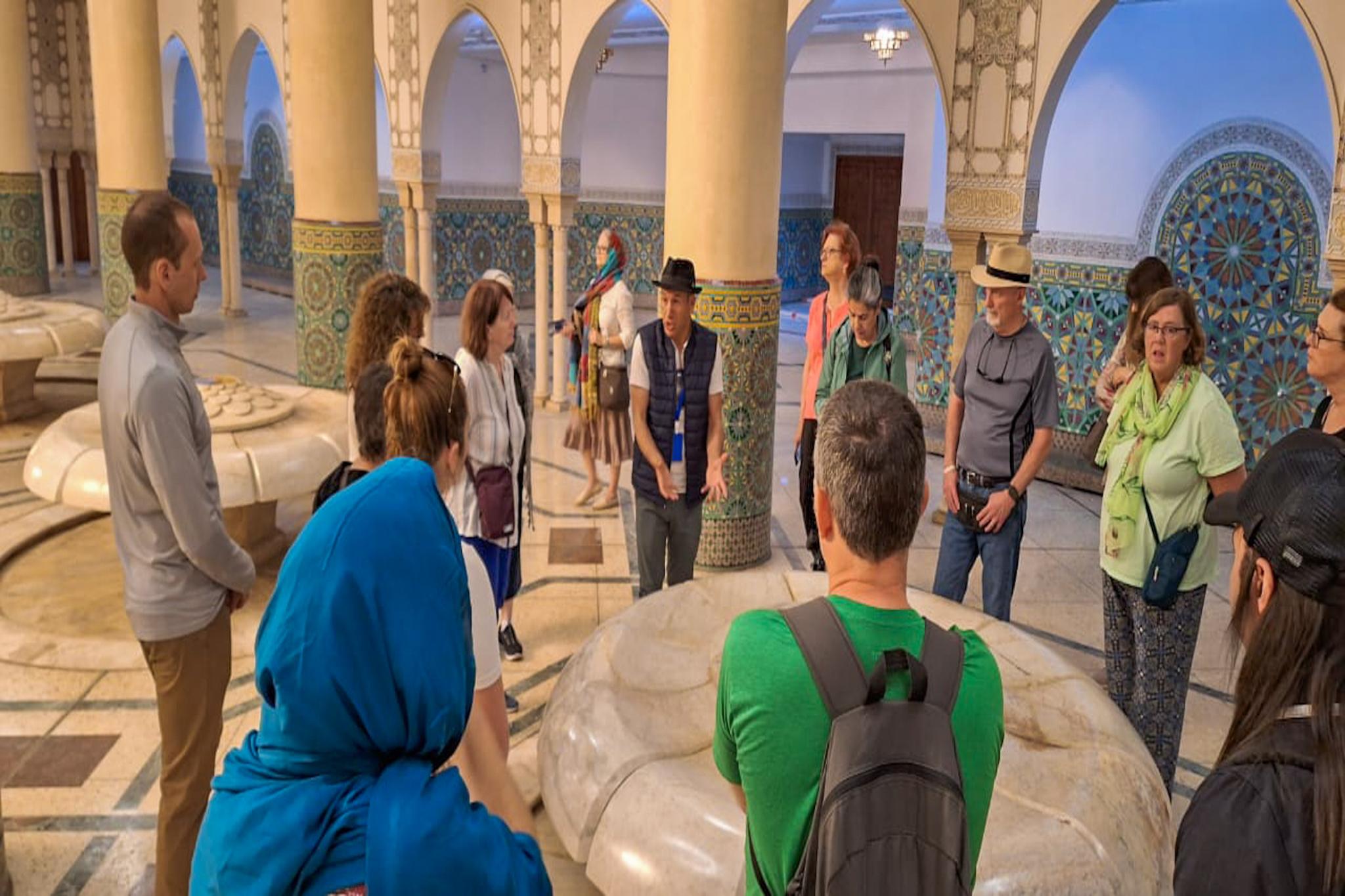
Descend to see the marble ablution basins and the non-functioning hammam built for visitors.
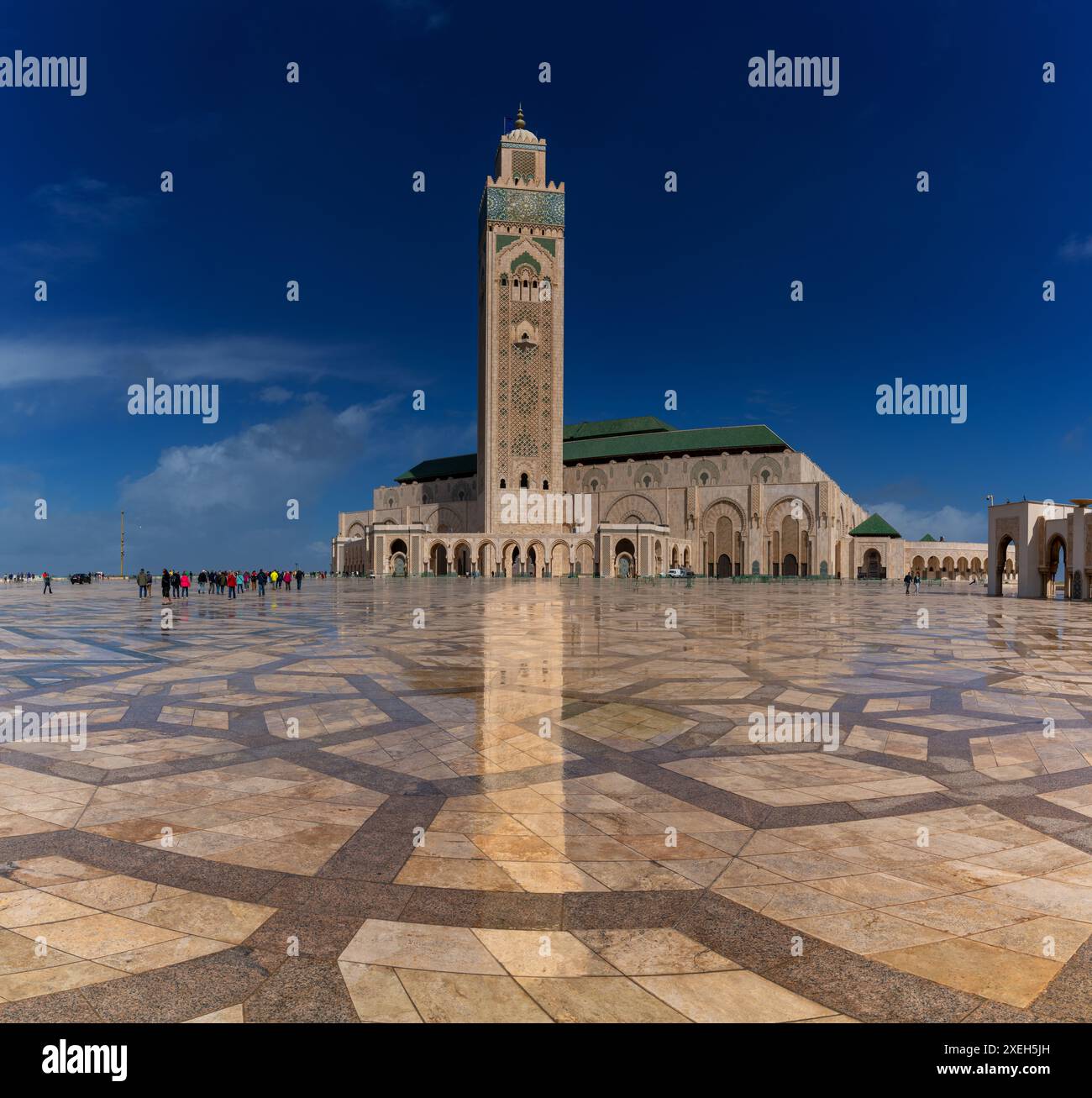
Step back onto the esplanade for photos of the 210-meter minaret against the Atlantic.
A 20,000 m2 interior seating 25,000 worshippers beneath a retractable roof, with cedar ceilings and Murano glass chandeliers imported from Italy.
At 210 meters, the world's second-tallest minaret rises 60 stories and is topped by a laser directed toward Mecca, visible up to 30 km at night.
An open esplanade courtyard capable of holding 80,000 additional worshippers outdoors, framed by carved marble arcades facing the Atlantic.
A subterranean chamber of marble basins beneath the prayer hall, built for ritual washing before prayer and rarely seen by casual visitors elsewhere in Morocco.
A traditional bathhouse built purely to complete the visitor experience, since it was never used for actual bathing and remains closed to the public.
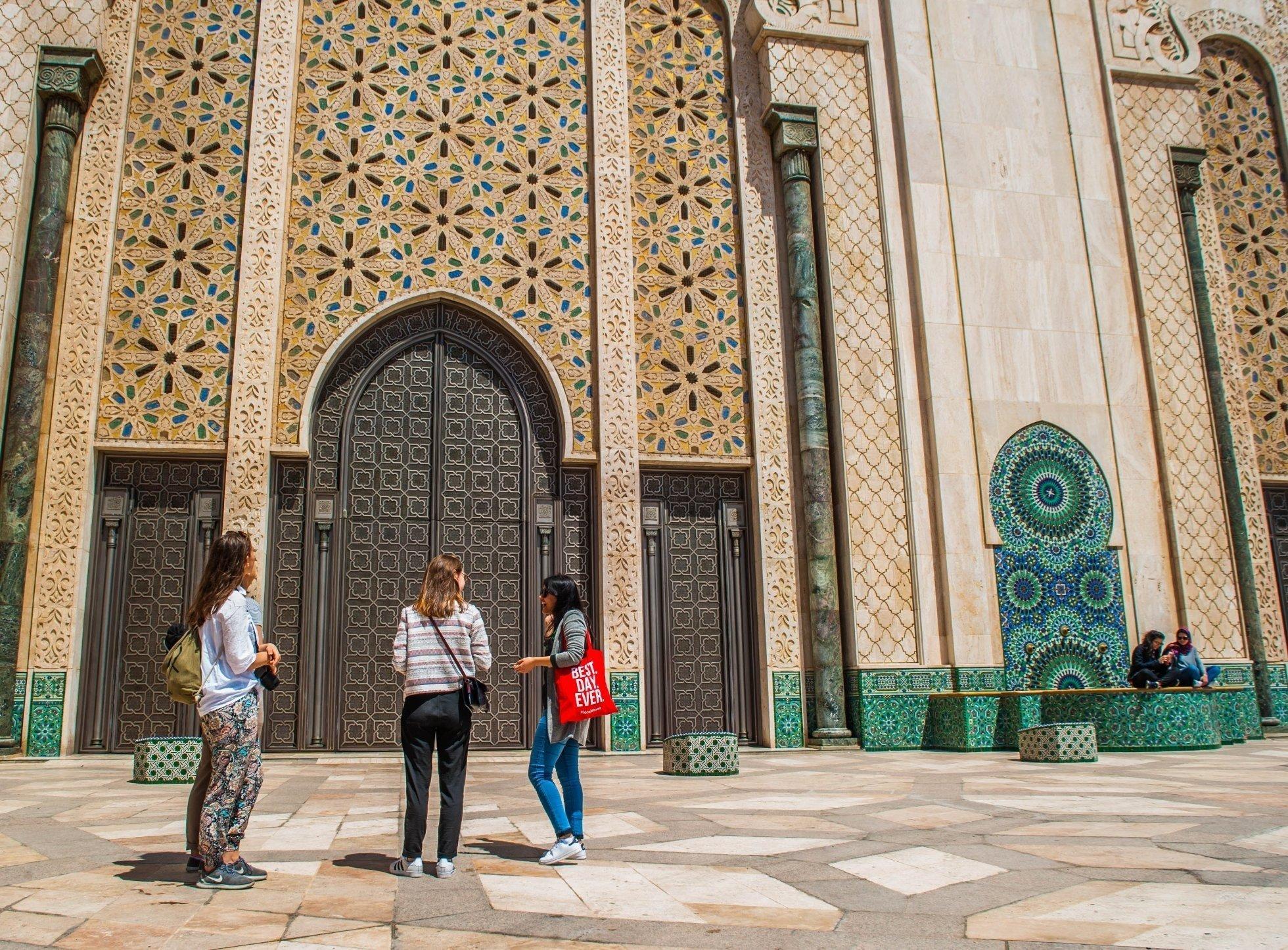
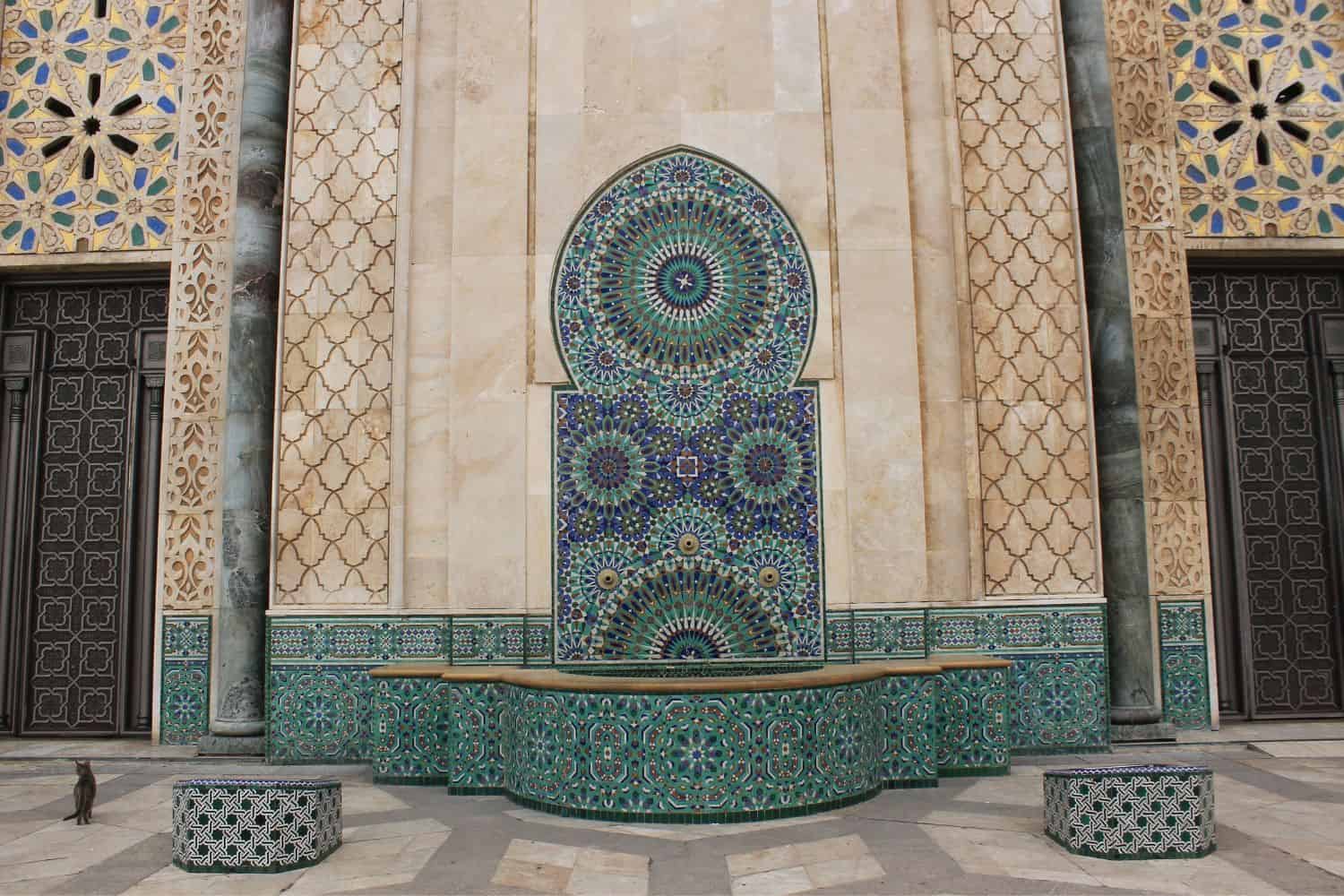
Roughly 10,000 m2 of hand-cut zellige tilework and 53,000 m2 of carved cedar wood cover the interior, produced by around 10,000 Moroccan artisans over seven years.
You arrive at the esplanade before the coaches, ideally in the 09:00–10:00 window, when the light comes low off the Atlantic and the marble reads warm rather than white. You cross a plaza large enough to hold 80,000 people and find it nearly empty. You buy your casablanca mosque tour tickets at the visitor centre on the north side, tucked into the terrace below the esplanade, and you wait beside the fountains for your language group to be called. You remove your shoes and carry them in the bag provided. You step through the titanium doors and the temperature drops. Your guide walks you the length of the prayer hall — roughly 200 metres — pausing beneath the central chandeliers, then at the mihrab, then at the carved cedar galleries above, where the women's mezzanine holds another 5,000. You look up when the roof is open and see sky through a rectangle of cedar. You descend a broad marble staircase to the ablutions hall. The vaulting is low here, the lotus fountains are cool, and the noise from above disappears entirely. Your guide points out the hammam, unused but complete. You come back up, collect your shoes, and step out into full sun. A single casablanca mosque tour tour runs about an hour. You walk the seawall afterwards, where the waves break against the platform your feet were standing on.
All the details about your upcoming adventure in one place
A casablanca mosque tour takes you inside Hassan II Mosque, one of the few working mosques in Morocco open to non-Muslim visitors. Guides walk you through the vast prayer hall, the retractable cedar roof, the hand-cut zellij tilework, and the underground hammam and ablution fountains, with the Atlantic breaking against the seawall just outside. Most casablanca mosque tour tickets are timed to a specific guided departure, so the visit follows a fixed slot rather than open wandering.
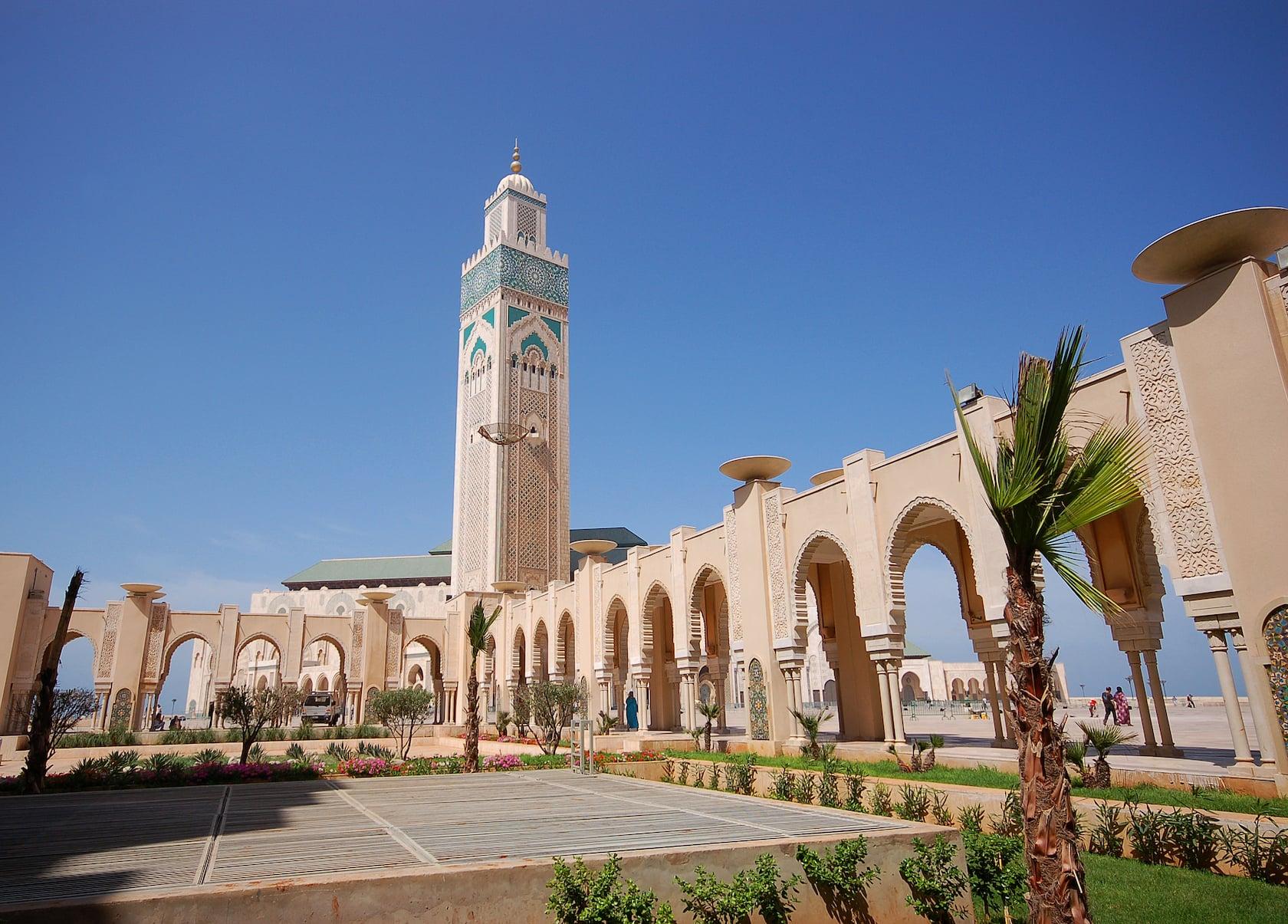
A third of the Hassan II Mosque stands over water — the prayer hall's seaward flank is built on a platform above the Atlantic, so that worshippers kneel on reclaimed rock with the ocean moving beneath them. The building was completed in 1993 to designs by the French architect Michel Pinseau, and its minaret rises 210 metres, still among the tallest religious structures on earth. That is the frame; the substance lies in what the building does with space and material. It is one of a small number of mosques in Morocco open to non-Muslim visitors, which is why the casablanca mosque tour occupies an unusual place among North African cultural visits. Access is by guided session only, in French, English, Spanish, Arabic or German, and the arrangement is deliberate: the mosque remains a working place of prayer, and the tour is scheduled around the five daily prayers rather than around tourism. Visitors enter the same halls the congregation uses hours later. That continuity is rare among world monuments of comparable scale. The architecture rewards slow looking. Some 6,000 Moroccan master craftsmen — zellige mosaicists, gebs plasterers, cedar carvers from the Middle Atlas — worked the interior surfaces by hand. The prayer hall accommodates 25,000 people beneath a retractable cedar roof that opens to the sky in fair weather. Underfoot, granite and marble are heated. Above, chandeliers of Murano glass hang in ranks along the central nave. Below the prayer hall lies the ablutions level, where lotus-shaped marble fountains sit under low vaulting, and beyond it a hammam that was part of the original programme. The titanium doors, the pink granite from Tafraoute, the green zellige tilework in geometries that repeat without ever quite resolving — these reward the kind of attention that guided commentary makes possible. Most Casablanca landmarks are read from the street. This one is read from the inside, at close range, with someone explaining what the pattern means. The mosque sits at the western edge of the city on Boulevard Sidi Mohammed Ben Abdellah, its esplanade facing open water, deliberately separate from the art deco downtown. Approaching on foot along the corniche gives the building its intended scale. Guided visits run 09:00–16:00 Monday through Thursday and Saturday and Sunday, and 09:00–15:00 on Friday, with entry at 140 MAD for foreign adults including the mandatory guide. Booked in advance, a casablanca mosque tour resolves into something closer to an architecture lesson than a sightseeing stop — one that most casablanca mosque tour tours cannot replicate elsewhere in the country, because elsewhere the doors stay closed.
A third of the mosque stands over water, and the ocean is audible from inside the prayer hall.
Modest dress is required for entry: shoulders, knees, and midriff must be covered for both men and women, and women are not required to cover their hair. Loose scarves or wraps are useful if your outfit falls short, and flip-flops are fine since shoes come off before the prayer hall.
A walk-through metal detector and bag check sit at the visitor entrance on Boulevard Sidi Mohammed Ben Abdellah, so arrive a few minutes before your slot to clear the line. Large backpacks, suitcases, and hard-shell cases are discouraged since there is no dedicated cloakroom at the site.
Photography and video are permitted throughout the courtyard, prayer hall, and ablution areas during the guided tour, including tripods for still shots in the sahn. Drone flights over the esplanade are not allowed without prior authorization from mosque authorities.
Children under 6 enter free, and strollers can be wheeled across the flat marble esplanade without difficulty. There are no age restrictions on the guided tour itself.
Ramps and elevators serve the main prayer hall and courtyard, and the marble esplanade is flat and step-free from the ticket office to the entrance, roughly 500 meters. A few interior sections, including stairs near the minaret base, are not wheelchair accessible, so guides can route around these on request.
Eating and drinking are not permitted inside the prayer hall, ablution rooms, or during the guided tour itself. Bottled water may be carried in a small bag but should be consumed outside on the esplanade rather than in the interior spaces.
Slightly quieter than weekend
Shorter hours, no midday slot
Busiest day, tour buses arrive
Family groups common
Guided tour hours
09:00–16:00 most days (Fri 09:00–15:00)
Address
Boulevard Sidi Mohammed Ben Abdellah, Casablanca, Morocco
Wheelchair access
Ramps and elevators in main prayer hall and courtyard
Best arrival window
09:00–10:00 for soft morning light and smaller crowds
Bag policy
Small bags allowed, no large backpacks or luggage
Ticket includes
140 MAD foreign adult, includes mandatory guided tour
Public transport · 20-30 min · Around 8 MAD tram fare
Take the T1 tram from Casa-Port station toward Sidi Moumen and get off at Place des Nations Unies, then walk about 10-15 minutes to the mosque entrance.
Taxi · 10-15 min · 15-30 MAD
Red petit taxis run directly from central Casablanca to the mosque complex, a 3-4 km ride; confirm the meter is running before departing.
Car · 10-20 min from downtown · Parking fee varies
Drivers can follow Boulevard de la Corniche along the waterfront directly to the site, with paid parking available near the esplanade, though spaces fill during peak morning hours.
Walk · 30-40 min · Free
From Casa Port train station it's roughly a 2 km walk along the coast to the mosque, flat and scenic but exposed to sun and wind.
Tickets for the Casablanca mosque tour booked directly through the mosque's ticket office are non-refundable once purchased on-site, since the 140 MAD fee is collected at the door before each scheduled tour departure. Third-party operators offering a casablanca mosque tour tours package typically allow free cancellation up to 24 hours before the scheduled slot, with refund terms set by that specific operator rather than the mosque itself.
Recommended time
2-2.5 hours
The mosque-run guided tour itself runs about 40-60 minutes, but a proper casablanca mosque tour needs closer to two hours once you count arrival. Add 30-45 minutes before the tour for buying tickets and clearing security, since queues at the onsite desk can stretch out the door on a bad morning. Afterward, keep 20-30 minutes free to walk the esplanade and corniche boardwalk, where the exterior views are free and worth lingering over. Skip-the-line mosque visits or a private casablanca mosque tour tour can trim the queue portion, but not the tour length itself, since guides move all groups at the same fixed pace.
Crowd levels through the day
Weather · crowds · average price — dots go green to amber to red as each metric rises.
Cooler Atlantic air and the shortest queues of the year make this the calmest season for a casablanca mosque tour, with wait times often under 20 minutes. Overcast days are common, softening the light on the white marble facade.
Mild temperatures around 18-22°C and blooming jacaranda trees nearby make spring a comfortable stretch for visiting, before summer crowds build. This is a strong season for pairing the mosque with a broader Casablanca landmarks walk.
Peak tourist season brings the heaviest crowds and midday queues that can stretch 30-60 minutes, alongside warm, humid coastal weather in the high 20s°C. Early slots fill fastest during these months.
Crowds thin out after the summer rush while temperatures stay pleasant, making September and October a practical shoulder-season window for a casablanca mosque tour with fewer tour buses.
MAD cash in small denominations speeds up the ticket window and avoids change issues at the entrance.
Guides rotate through French, English, Spanish, and Arabic groups, so ask which language slot is next if timing matters.
Shoes come off before the prayer hall, so slip-ons save time over laces during the security queue.
The esplanade sits directly on the Atlantic, so a light jacket helps even on warm days.
The seafront promenade is a short walk away and pairs naturally with a mosque visit for a half-day outing.
Some casablanca mosque tour tickets sold online bundle hotel pickup or a city tour, so check exactly what is included before booking.
Boulevard Sidi Mohammed Ben Abdellah, Casablanca
Ticket office and security checkpoint for all guided tour groups
Get directionsBoulevard de la Corniche side, Casablanca
Common gathering spot for private tour operators before entry
Get directionsIn 1980, King Hassan II announced a mosque for Casablanca and asked Moroccans to fund it. Public subscription raised a substantial share of the cost. The site was deliberate: reclaimed land at the Atlantic's edge, west of the old medina, on what is now Boulevard Sidi Mohammed Ben Abdellah. The king cited a Quranic verse describing God's throne upon the water. Every visitor on a casablanca mosque tour stands on ground that was ocean and rubble before 1986. The French architect Michel Pinseau drew the plans. Bouygues held the contract. Work began on 12 July 1986 and ran until 1993, with crews reportedly working around the clock in the final years. Roughly 6,000 Moroccan master craftsmen — zellij tilers, plaster carvers, cedar woodworkers from Fez and Marrakech — executed the ornamental programme by hand. Industrial methods framed the building; traditional ateliers finished it. That division explains the texture visitors notice on any Hassan II Mosque tour: machine precision beneath handmade surface. Engineering answered the site. The 210-metre minaret, among the tallest religious structures in the world, required high-strength concrete formulated to resist Atlantic salt spray and wind loading. A titanium-clad retractable roof over the prayer hall opens in minutes, admitting sky into a space holding 25,000 worshippers. Sections of glass floor above the ablution level let the faithful see the water beneath. Marble came largely from Agadir and Tadla; Venetian glass was an exception to an otherwise Moroccan material list. Inauguration fell on 30 August 1993, the eve of the Prophet's birthday. Salt corrosion appeared early, and restoration campaigns from the 2000s onward replaced damaged stone and reinforced the seawall. Since 1993 the mosque has been the fixed image of Casablanca landmarks, the one building the city exports. It is also one of few Moroccan mosques admitting non-Muslims, which made structured casablanca mosque tour tours possible at all. Purchasing casablanca mosque tour tickets funds continued conservation; a guided casablanca mosque tour tour includes the hammam level, unfinished and rarely used. Details are at https://www.fmh2.ma/en/mosque/visits/paid-guided-tour.
King Hassan II announces the project and opens a national public subscription to finance it.
Construction begins on 12 July on reclaimed coastal land west of the old medina.
Around 6,000 Moroccan craftsmen execute zellij, carved plaster and cedar work by hand.
Engineers pour high-strength salt-resistant concrete for the 210-metre minaret.
The mosque is inaugurated on 30 August, the eve of the Prophet's birthday.
Restoration campaigns begin addressing Atlantic salt corrosion and seawall damage.
The mosque remains one of the few in Morocco open to non-Muslim visitors.
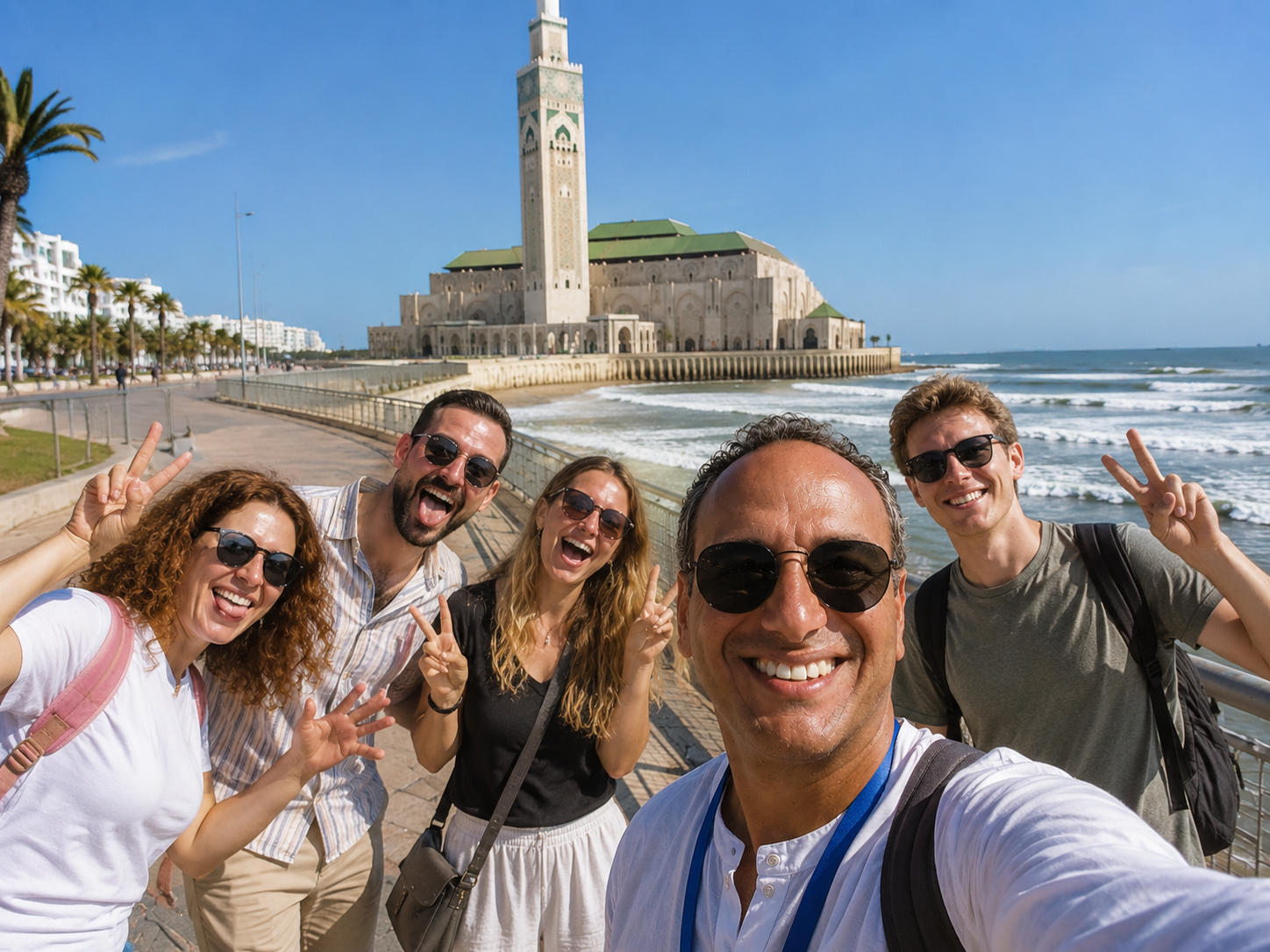
The classic wide shot places the entire mosque against the Atlantic coastline, with waves breaking against the sea wall in the foreground. Walk west along the boardwalk until the whole facade and minaret fit in one frame; this stretch is the anchor of most casablanca mosque tour photo itineraries. Late afternoon light warms the limestone and deepens the ocean color.
From the edge of the main public esplanade, look through the sequence of carved horseshoe arches toward the minaret rising behind them, a framing device used in most casablanca mosque tour tours. Stand a few meters back from the arcade so the columns stack in the frame rather than blocking it. Midday sun brings out the zellige detail on the arch surfaces.
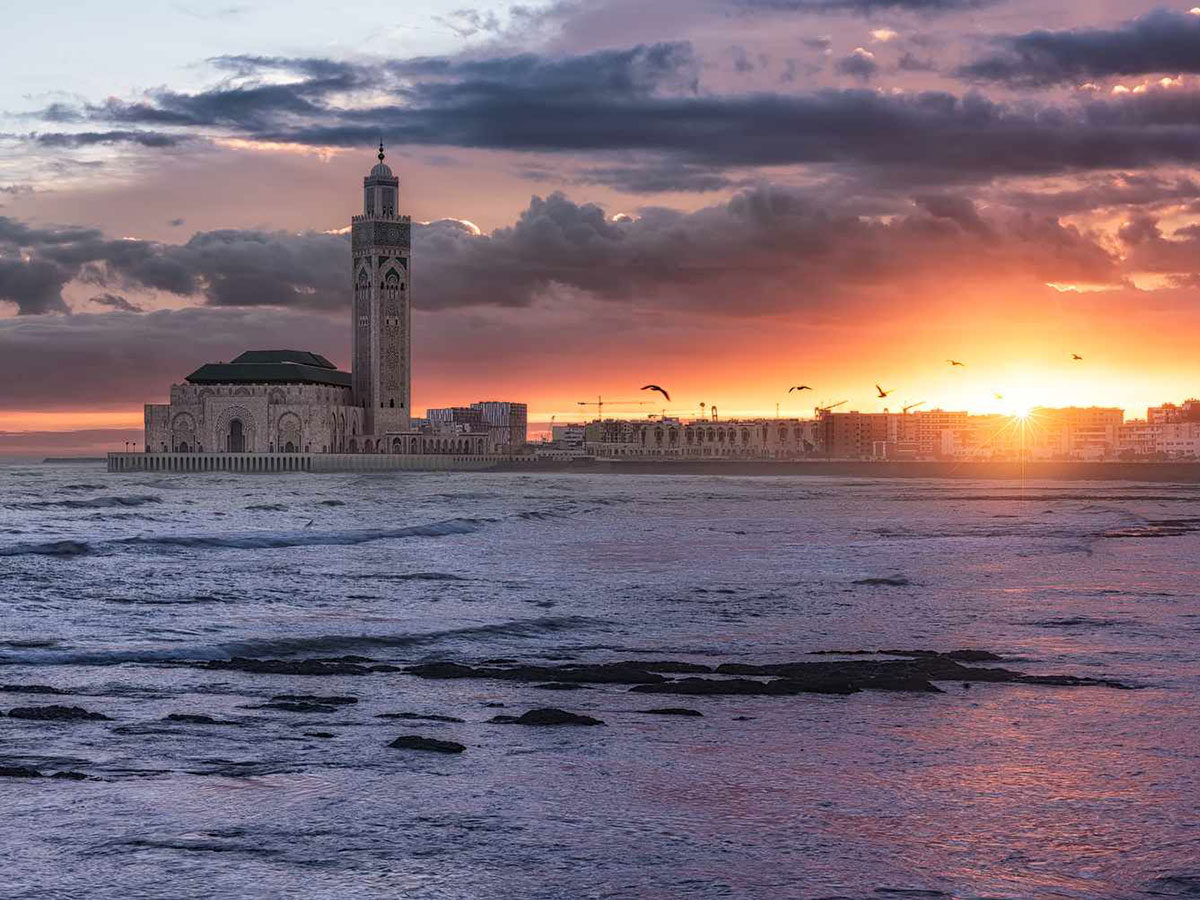
From the rocks and sea wall directly north of the mosque, the minaret dominates the skyline while the sun drops behind it, silhouetting the tower against orange sky. Footing on the wet rocks is uneven, so sturdy shoes help. This angle is popular for the casablanca mosque tour tour season around sunset.
A shallow tidal pool area near the base occasionally mirrors the mosque and minaret on calm days, giving a symmetrical reflection shot. Position low, close to the water's edge, and check tide conditions beforehand since the pool isn't always present.
The vaulted entry corridor near the ticket area gives a tighter architectural shot of carved stonework and geometric tilework, good for detail-focused frames distinct from the exterior skyline views, and useful for anyone researching casablanca mosque tour tickets photography angles beforehand.
A casablanca mosque tour is doable with young children, but the marble courtyard and long guided walk mean strollers and toddlers need a plan. Kids under 6 enter free, which helps if your visit runs longer than expected.
Marble floors and shallow steps around the courtyard are stroller-friendly overall, but the crowded entry queue and narrow security checkpoint make a compact umbrella stroller far easier than a full-size one. Carrying younger toddlers for parts of the tour is common among parents.
Children over 5 or 6 generally follow the guide's pace and stay engaged with the scale of the prayer hall; toddlers under 3 often tire during the standing explanations. Since admission is free for children under 6, families with a mixed-age group aren't penalized for bringing everyone along.
There are no baby-changing stations inside the mosque itself, so plan diaper changes before arrival. Public restrooms exist near the ticket office, but come prepared with wipes and a portable changing pad.
The tour lasts roughly 40 to 60 minutes with continuous walking and standing, no seating breaks along the route. Position yourselves near the front of the group so kids can see and hear, and expect to carry a tired child through the final third.
No snacking is possible during the tour itself, so feed children beforehand and pack a small water bottle for after, since none is sold inside.
Most of the route stays covered, so a casablanca mosque tour still works well on a wet morning, unlike open-air Casablanca landmarks nearby.
There is no restaurant inside Hassan II Mosque itself, so most people leaving a casablanca mosque tour walk or taxi a short distance to eat, with the strip between the old medina and the Ain Diab Corniche covering everything from cinema-famous dining rooms to seafront grills.
Modeled on the film set, this Boulevard Sour Jdid mansion serves sole meunière, steaks, and seafood pasta with live piano; lunch service from noon suits a late-morning finish, and reservations help since tables fill fast.
Tucked into the old medina ramparts a short stroll from the mosque, this garden courtyard spot opens from 8am for tagines, briouates, and mint tea; mornings and early afternoons are calmer than dinner service.
Perched over the Atlantic near the El Hank lighthouse, it pairs oysters and grilled fish with mosque and ocean views; best for a leisurely lunch after skip-the-line casablanca mosque tour tickets, though a taxi is needed to reach the Corniche.
Along Boulevard de la Corniche, informal cafés and grill stalls serve grilled sardines, calamari, and mint tea; useful for a quick, inexpensive bite between Casablanca landmarks tours without a reservation.
Real experiences from real travelers
The casablanca mosque tour was the reason we routed through the city at all, and the scale of the prayer hall genuinely surprised me — the cedar ceiling opens and you can hear gulls. Our guide explained the zellige patterns without rushing anyone. Bring something for the glare off the esplanade, it is fierce in June.
Standing under the chandeliers with light coming through the open roof is something photos undersell. What I appreciated most was how our guide handled the crowd flow so we were never stuck behind another group. The Atlantic wind on the platform was cold even in May.
We booked casablanca mosque tour tickets a few days ahead and still ended up in a large group. The ablution hall downstairs with the lotus fountains was the quiet highlight — cool air, dripping water, almost empty. Worth going even with the crowding.
Notre visite guidée de la mosquée Hassan II était excellente — the guide switched between French and English easily. The carved stucco near the mihrab is finer than anything I saw elsewhere in Morocco. Wear shoes you can slip off quickly.
Grey overcast morning, which actually suited the pink granite and made the interior lighting stand out. Among Casablanca landmarks this is the one that justifies the stop. The guide pointed out the titanium doors, which I would have walked straight past.
Cold wind off the ocean and almost no queue in January, so the casablanca mosque tour felt unhurried. The scale of the hall — twenty-five thousand people, apparently — is hard to process from inside. Our guide was patient with questions about the minaret laser.
Did a Casablanca mosque guided tour in the late afternoon and the light coming across the esplanade was extraordinary. The hand-carved cedar work near the entrance doors deserves more time than the itinerary allows. Sea spray reaches the paving when the tide is up.
We took a skip-the-line Hassan II Mosque entry and it did save us a long wait outside in the heat. Inside, the marble underfoot stays cool which was a relief. The guide's explanation of the retractable roof mechanism was the part my partner still talks about.
The mihrab detailing and the Murano glass fixtures are the kind of thing you only notice when someone points them out. Casablanca mosque tours run frequently enough that we changed our slot on the day without trouble. Humid afternoon, but the hall itself was cool.
Knowing the whole platform sits over the water changes how you look at it — you can see the Atlantic through the glass floor section. A casablanca mosque tour tour with a good guide is the only way to catch details like the titanium and brass doors. Went at 2pm, sun was harsh outside and welcome inside.
Everything you need to know for your journey
The Hassan II Mosque guided tour runs 09:00–16:00 Monday through Thursday and Saturday-Sunday, and 09:00–15:00 on Friday.
A standard foreign adult ticket for the casablanca mosque tour costs 140 MAD, which includes the mandatory guided tour.
Yes, ramps and elevators serve the main prayer hall and courtyard, and the marble esplanade is flat and step-free for most of the route.
Small bags are fine, but large backpacks and suitcases are discouraged since there's no dedicated cloakroom at the entrance.
Photography and video are allowed throughout the courtyard and prayer hall during the tour, though drones require prior authorization.
Arriving between 09:00 and 10:00 gives the softest morning light and the smallest crowds before tour buses arrive later in the day.
Shoulders, knees, and midriff should be covered for both men and women; hair covering is not required.
Eating and drinking are not permitted inside the prayer hall or ablution areas, though bottled water can be carried in a small bag.
The T1 tram to Place des Nations Unies plus a short walk, or a red petit taxi directly to the entrance, are the easiest options for a Casablanca mosque tour without a car.
Yes, children under 6 enter free and the flat esplanade is manageable with strollers, making it a common family stop in Casablanca.
Tickets bought on-site are non-refundable, though many third-party casablanca mosque tour tickets allow free cancellation up to 24 hours ahead depending on the operator.
The Corniche Ain Diab promenade, the Old Medina, and Casablanca Cathedral are all within a short taxi or walk and pair well with the mosque for a half-day Casablanca landmarks itinerary.
Casablanca's seafront promenade lined with cafes and beach clubs, popular for sunset walks after visiting the mosque.
A compact walled quarter near the port with narrow lanes, spice stalls, and a smaller, quieter souk than Marrakech's.
A disused French colonial-era Catholic cathedral built in the 1930s, notable for its Art Deco concrete facade.
Central square and transit hub linking the tram network to the old medina and downtown boulevards.
Waterfront hotel near the United Nations Square with direct tram access to the mosque area.
Business-district hotel convenient for combining downtown sightseeing with a mosque visit.
Beachfront neighborhood with mid-range hotels and easy Corniche access near the mosque.
Traditional courtyard guesthouses close to the port and a short walk from the mosque esplanade.
Join thousands of happy travelers who have discovered this incredible experience
Book Your Experience Now